What Kind of Animal Do Both Lady Macduff and Macduff Use to Talk About Their Family
| Lady Macduff | |
|---|---|
| Macbeth character | |
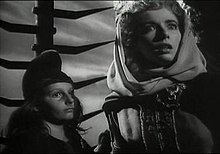 Peggy Webber (right) as Lady Macduff in Orson Welles' motion picture adaptation Macbeth (1948 film) | |
| Created by | William Shakespeare |
| In-universe information | |
| Spouse | Macduff |
| Children | Son (proper name unknown) |
Lady Macduff is a character in William Shakespeare's Macbeth. She is married to Lord Macduff, the Thane of Fife. Her appearance in the play is brief: she and her son are introduced in Deed IV Scene Ii, a climactic scene that ends with both of them being murdered on Macbeth'due south orders. Though Lady Macduff's advent is limited to this scene, her function in the play is quite significant. Later playwrights, William Davenant especially, expanded her role in adaptation and in performance.
Origin [edit]
Macduff and Lady Macduff appear in both Raphael Holinshed's Chronicles (1577) and Hector Boece'due south Scotorum Historiæ (1526).[1] Holinshed's Chronicles was Shakespeare's main source for Macbeth, though he diverged from the Chronicles significantly by delaying Macduff'southward knowledge of his married woman'due south murder until his arrival in England. The latter function of Act Four Scene III is "wholly of Shakespeare's invention."[2]
Role [edit]
In Deed IV Scene Two, Lady Macduff appears alongside the thane of Ross and her unnamed son. She is furious at her husband for his desertion of his family. Ross attempts to comfort her, though he offers niggling alleviation and Lady Macduff responds with sharp retorts that betray her anger toward her hubby. Claiming to be overcome with emotion, Ross takes his exit. Lady Macduff is left with her son, whom she speaks with, her fury toward Macduff mingling with her affection for her child. This domesticity is interrupted by the arrival of a messenger who warns her of imminent danger and urges her to escape with her children. Lady Macduff is alarmed and moments later on, the scene is invaded by a group of murderers sent by Macbeth. The son is killed starting time and he urges his female parent to flee. She heeds his words and exits the scene screaming, "Murder!".[3] She is killed off-stage, one of several significant offstage murders in the play.
Assay of Lady Macduff [edit]
Lady Macduff's entire portrait as a graphic symbol is painted in this 1 scene, though it is clear through her deportment that she is a fiercely protective mother and a woman who is non afraid to speak out against others. She speaks out unabashedly against her husband's disloyalty, saying "He loves united states not"[4] and "His flight was madness."[5] When one of the murderers asks where her husband is she bravely replies, "I hope in no place so unsanctified / Where such as g mayst find him."[6] These interactions with other characters reveal her outspokenness.
Lady Macduff challenges her husband's actions, questioning, "What had he done to brand him fly the state?"[7] and raising a question of loyalty that the play never fully resolves.[8]
This challenge is immediately taken up by Macduff in the next scene, Act 4 Scene 3. When Ross enters to tell him of the news of his wife and children'south death, he immediately asks after his married woman and children. Macduff's fearfulness for their safety and guilt is apparent, specially when he questions, "The tyrant has not dilapidated at their peace?".[nine] When he finally hears the news, his reaction suggests both shock and guilt. He asks multiple times if his married woman and "pretty ones" are actually dead. The murder of Macduff's family and his daze at this issue convince Malcolm of Macduff's trustworthiness and disloyalty to Macbeth.[10]
Lady Macduff and Lady Macbeth [edit]
Lady Macduff and Lady Macbeth are two who, "share some bones qualities just diverge in others".[11] Though Lady Macduff is a foil to Lady Macbeth, they are non entirely opposites. Similar Lady Macbeth, Lady Macduff has a husband who has abandoned her with the intention to manipulate power. Both feel the pain of loss and neither entirely understands her spouse. The contrasts are just as clear and ironic. Lady Macbeth believes her husband to be also full of the "milk of human kindness",[12] while Lady Macduff is furious at her husband for his unkind abandonment of his family. Lady Macduff is a domestic and caring figure: her scene is i of the few times when kid and parent are seen together, parallel to an earlier scene between Banquo and his son Fleance.[xi] These nurturing parents dissimilarity starkly with Lady Macbeth's exclamation that she would dash her child'due south brains out rather than give up her ambitions.[13] Lady Macbeth has control over her husband's action at the commencement while Lady Macduff did not accept command equally Macduff just left Lady Macduff without her consultation.
Functioning history [edit]
Later playwrights have found the parallels between Ladies Macduff and Macbeth fascinating and expanded Lady Macduff's role in the play to directly contrast with Lady Macbeth and her actions. Sir William Davenant inaugurated this strategy in his adaptation of 1674,[fourteen] as part of his larger effort to brainwash the English populace on the proper discipline of human being emotions.[15] Davenant greatly expanded Lady Macduff's part, having her appear in four new scenes: "the offset with Lady Macbeth, the 2nd with her married man in which they are visited by the witches, the tertiary in which she tries to dissuade him from opposing Macbeth, and the fourth where, hearing of Banquo'southward murder, she urges Macduff to abscond to England."[xiv] These revisions greatly increased her part as a foil to Lady Macbeth, with Lady Macbeth dedicated to evil and Lady Macduff dedicated to good.
In later performances of Macbeth, especially during the eighteenth century, the violence of the murder of children could not exist tolerated and Act 4 Scene 2 was by and large deleted even as belatedly every bit 1904.[xi] Samuel Taylor Coleridge argued for the tragic effectiveness of this scene:
"This scene, dreadful as it is, is nevertheless a relief, because a diversity, because domestic, and therefore soothing, as associated with the only real pleasures of life. The conversation between Lady Macduff and her kid heightens the pathos, and is preparatory for the deep tragedy of their assassination."
References [edit]
- ^ Davis, J. Madison, and A. Daniel Frankforter. " The Shakespeare Name Dictionary . London: Routledge, 2004. 568–569. Impress.
- ^ Holinshed, Raphael, and W. G. Stone. Shakespeare's Holinshed; The Chronicle and the Historical Plays Compared. New York: B. Blom, 1966. Print.
- ^ Macbeth Act 4 Scene 2 cease phase directions. Shakespeare Navigators.
- ^ Macbeth Human activity 4 Scene ii line 8. Shakespeare Navigators.
- ^ Macbeth Deed 4 Scene two line 3. Shakespeare Navigators.
- ^ Macbeth Act four Scene two line 81–82. Shakespeare Navigators.
- ^ Macbeth Act 4 Scene 2 line 1. Shakespeare Navigators.
- ^ Orgel, Stephen. "Macbeth." Introduction. Complete Pelican Shakespeare. New York: Penguin Classics, 2002. Impress.
- ^ Macbeth Act 4 Scene 3 line 178. Shakespeare Navigators.
- ^ Rosenberg, Marvin. "Act IV, Scene three." The Masks of Macbeth . Berkeley: University of California Press, 1978. Impress.
- ^ a b c Rosenberg, Marvin. "Act Iv, Scene two." The Masks of Macbeth . Berkeley: University of California Press, 1978. 531–542. Print.
- ^ Macbeth Act 1 Scene v line 17. Shakespeare Navigators.
- ^ Fawkner, Harald William. Deconstructing Macbeth: the hyperontological view. Rutherford [N.J.: Fairleigh Dickinson University Press ;, 1990. Print.
- ^ a b Shakespeare, William, and John Wilders. "Restoration 'Macbeth': Davenant." Macbeth . Cambridge, UK: Cambridge University Press, 2004. 7–11. Print.
- ^ Paster, Gail Kern, Katherine Rowe, and Mary Wilson. "Humoral Cognition and Liberal Knowledge in Davenant's Macbeth." Reading the Early Modern Passions: Essays in the Cultural History of Emotion. Philadelphia: University of Pennsylvania Press, 2004. 169–191. Print.
External links [edit]
- [ane] Complete Text of Shakespeare'south Macbeth
Source: https://en.wikipedia.org/wiki/Lady_Macduff
0 Response to "What Kind of Animal Do Both Lady Macduff and Macduff Use to Talk About Their Family"
Postar um comentário