Can You Recognize the Eight Stages of Meiosis Based on the Location and Behavior of the Chromosomes
Learning Objectives
- Draw the chromosomal makeup of a cell using the terms chromosome, sister chromatid, homologous chromosome, diploid, haploid, and tetrad
- Recognize the part and products of mitosis and meiosis
- Compare and contrast the behaviors of chromosomes in mitosis and meiosis
- Recognize when cells are diploid vs. haploid
- Predict DNA content of cells in unlike phases of mitosis and meiosis
- Call back and describe the phases of the jail cell cycle
- Relate the cell wheel stages to changes in DNA content
The Cell Sectionalisation Wheel
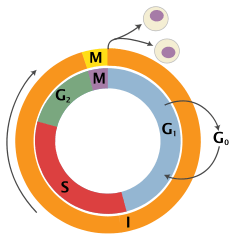
Cell division cycle, figure from Wikipedia. Cells that stop dividing exit the G1 stage of the cell cycle into a so-called G0 state.
Cells reproduce genetically identical copies of themselves by cycles of cell growth and partitioning. The cell bike diagram on the left shows that a cell partitioning cycle consists of iv stages:
- G1 is the menstruation after prison cell division, and before the commencement of DNA replication. Cells grow and monitor their surroundings to determine whether they should initiate another round of cell division.
- S is the catamenia of Deoxyribonucleic acid synthesis, where cells replicate their chromosomes.
- G2 is the period between the end of Dna replication and the start of cell division. Cells check to make sure DNA replication has successfully completed, and brand any necessary repairs.
- M is the actual catamenia of jail cell division, consisting of prophase, metaphase, anaphase, telophase, and cytokinesis.
Chromosomes
Chromosomes were first named by cytologists viewing dividing cells through a microscope. The modern definition of a chromosome now includes the function of heredity and the chemical limerick. A chromosome is a Deoxyribonucleic acid molecule that carries all or part of the hereditary information of an organism. In eukaryotic cells, the Dna is packaged with proteins in the nucleus, and varies in structure and appearance at different parts of the jail cell bike.
Chromosomes condense and go visible by low-cal microscopy every bit eukaryotic cells enter mitosis or meiosis. During interphase (G1 + Southward + G2), chromosomes are fully or partially decondensed, in the grade of chromatin, which consists of Deoxyribonucleic acid wound around histone proteins (nucleosomes).
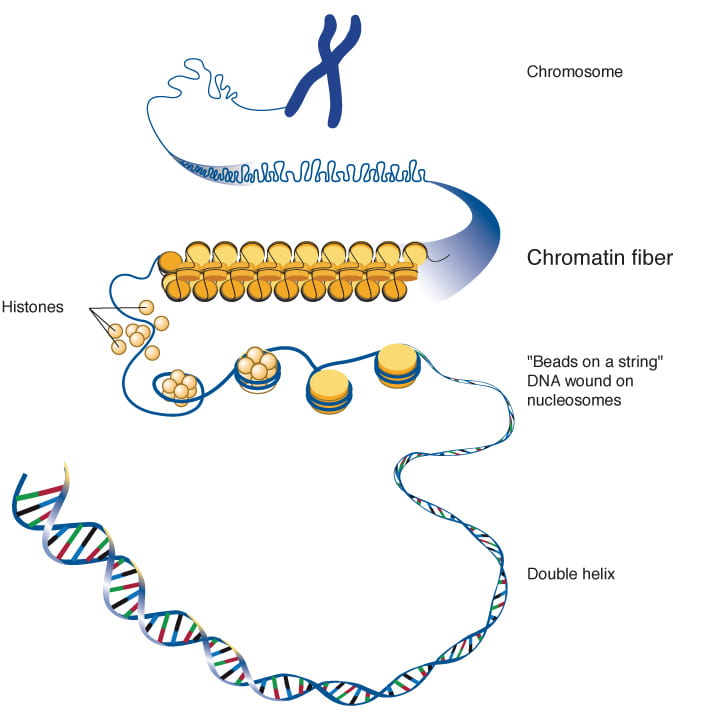
In G1, each chromosome is a single chromatid. In G2, after DNA replication in S phase, as cell enter mitotic prophase, each chromosome consists of a pair of identical sister chromatids, where each chromatid contains a linear DNA molecule that is identical to the joined sis. The sister chromatids are joined at their centromeres, as shown in the image below. A pair of sister chromatids is a single replicated chromosome, a single package of hereditary information.
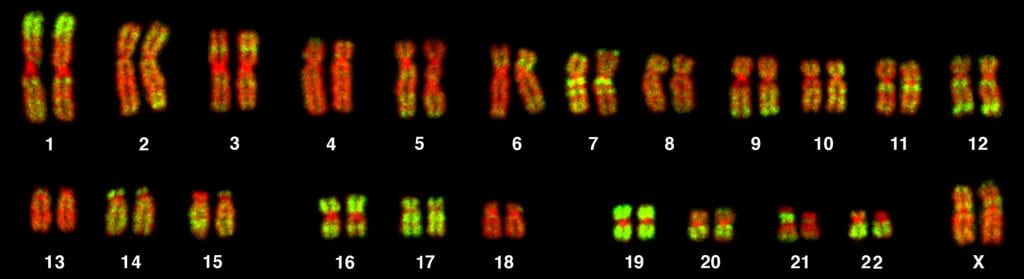
Human being karyotype "painted" using fluorescent Deoxyribonucleic acid probes. These mitotic chromosomes each consist of a pair of sister chromatids joined at their centromeres. The images of the homologous chromosome pairs (e.chiliad., 2 copies of chromosome i) have been lined upwards next to each other. Image from Bolzer et al., (2005) Three-Dimensional Maps of All Chromosomes in Human Male Fibroblast Nuclei and Prometaphase Rosettes. PLoS Biol 3(5): e157 DOI: 10.1371/journal.pbio.0030157
Ploidy
Humans are diploid, meaning we accept 2 copies of each chromosome. We inherited one re-create of each chromosome from other mother, and one re-create of each from our father. Gametes (sperm cells or egg cells) are haploid, pregnant that they accept but i consummate fix of chromosomes.
Chromosomes that do non differ betwixt males and females are called autosomes, and the chromosomes that differ between males and females are the sex chromosomes, X and Y for about mammals. Humans most normally have 22 pairs of autosomes and 1 pair of sex chromosomes (20 or XY), for a total of 46 chromosomes. We say that humans have 2N = 46 chromosomes, where N = 23, or the haploid number of chromosomes.
Cells with complete sets of chromosomes are called euploid; cells with missing or extra chromosomes are chosen aneuploid. The most common aneuploid condition in people is variation in the number of sexual activity chromosomes: XO (having just one re-create of the X), 30, or XYY. Having no Ten chromosome results in early embryonic expiry.
The two copies of a particular chromosome, such equally chromosome 1, are called homologous.The karyotype epitome above shows the homologous pairs for all the autosomes. Homologous chromosomes are not identical to each other, unlike sister chromatids. They oft accept different variants of the same hereditary information – such as blueish eye color vs chocolate-brown eye colour, or blood blazon A versus claret type B.
Mitosis
Mitosis produces two daughter cells that are genetically identical to each other, and to the parental cell. A diploid cell starts with 2N chromosomes and 2X DNA content. After DNA replication, the cells is notwithstanding genetically diploid (2N chromosome number), but has 4X Dna content because each chromosome has replicated its DNA. Each chromosome now consists of a joined pair of identical sister chromatids. During mitosis the sister chromatids carve up and go to opposite ends of the dividing cell. Mitosis ends with 2 identical cells, each with 2N chromosomes and 2X Deoxyribonucleic acid content. All eukaryotic cells replicate via mitosis, exceptgermline cells that undergo meiosis (see below) to produce gametes (eggs and sperm).
- prophase – chromosomes condense; each chromosome consists of a pair of identical sister chromatids joined at the centromere.
- metaphase – chromosomes line up at the eye of the cell, along the plane of cell segmentation, pushed and pulled by microtubules of the spindle apparatus
- anaphase – sister chromatids separate and migrate towards opposite ends of the cell
- telophase – chromatids cluster at contrary ends of the prison cell and brainstorm to decondense
- cytokinesis – the membrane pinches in to split up the two girl cells
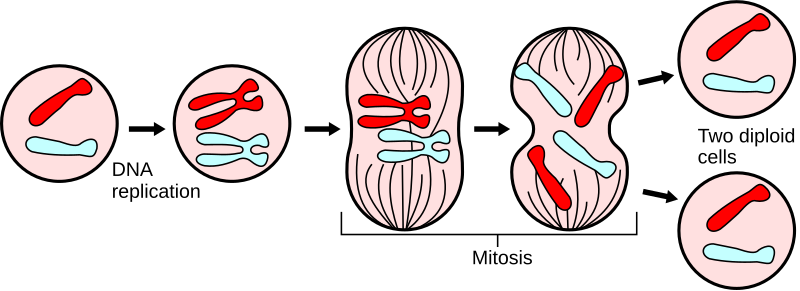
Here is a simplified diagram illustrating the overall process and products of mitosis:
Source: Wikimedia Commons (https://commons.wikimedia.org/wiki/File:MajorEventsInMeiosis_variant_int.svg)
Questions or points to ponder or note well-nigh the effigy above (answers at bottom of page):
- are the two daughter cells the same or dissimilar from each other, and from the parent cell at the start?
- why does the cartoon analogy of the chromosomes change (from a single rod to joined double rods) after DNA replication, and again (dorsum to unmarried rods) during mitosis?
- does the effigy testify 2 different chromosomes or a unmarried pair of homologous chromosomes?
- can haploid cells undergo mitosis? what most triploid cells (cells that have 3N chromosomes)?
This animation below shows the packaging of DNA and condensation of chromosomes as a jail cell undergoes mitosis.
The video narration has a major mistake at fourth dimension 1:22: chromosomes exist throughout the unabridged cell bike (at all times in a cell's life); they are visible in their condensed class simply during mitosis and meiosis.
Meiosis
This is a special sequence of ii cell divisions that produces haploid gametes from diploid germline cells. It starts with a diploid prison cell that has undergone chromosomal DNA replication: 2N chromosomes, 4X DNA content. 2 successive divisions, with no boosted DNA replication, results in 4 haploid gametes: 1N chromosomes, 1X DNA content.
NOVA has a skilful interactive side-past-side comparison of mitosis and meiosis on this page: How cells divide
Meiosis sets the stage for Mendelian genetics. Students need to know that near of the genetics action occurs in the first meiotic sectionalization:
- homologous chromosomes pair upward and align end-to-end (synapsis) in prophase I
- crossing over occurs between homologous chromosomes in prophase I, before chromosomes line upward at the metaphase plate
- homologous chromosomes carve up to daughter cells (sister chromatids do not separate) in the first division, creating haploid (1N) cells
- the separation of each pair of homologous chromosomes occurs independently, so all possible combinations of maternal and paternal chromosomes are possible in the two girl cells – this is the basis of Mendel's Law of Independent Assortment
- the first division is when daughter cells become functionally or genetically haploid
The last point appears to be the nigh difficult for students to grasp. Consider the X and Y chromosomes. They pair in prophase I, and so separate in the first division. The daughter cells of the first meiotic division take either an X or a Y; they don't accept both. Each cell at present has only ane sex activity chromosome, like a haploid jail cell.
One way of thinking about ploidy is the number of possible alleles for each gene a jail cell can accept. Correct subsequently meiosis I, the homologous chromosomes have separated into unlike cells. Each homolog carries i copy of the gene, and each cistron could be a different allele, but these 2 homologs are now in two different cells. Though it looks like there are two of each chromosome in each cell, these are duplicated chromosomes; ie, information technology is one chromosome which has been copied, and so there is simply 1 possible allele in the cell (just two copies of it).
The second meiotic partition is where sister (duplicated) chromatids divide. It resembles mitosis of a haploid cell. At the get-go of the 2d division, each cell contains 1N chromosomes, each consisting of a pair of sister chromatids joined at the centromere.
Hither is a simplified diagram illustrating the overall process and products of meiosis:
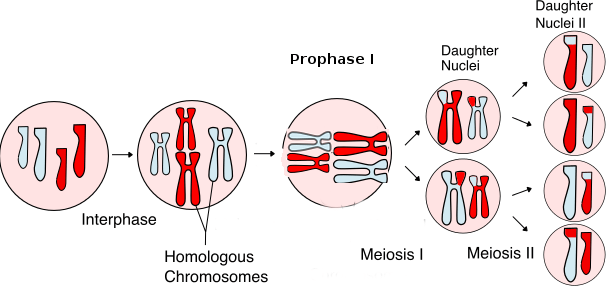
Meiosis Overview from Wikipedia by Rdbickel
And hither is a video that walks through the steps of meiosis:
It is very important that you recognize how and why cells become haploid later meiosis I.
To confirm for yourself that you understand meiosis, work through one or more of these interactive tutorials:
- The U. Arizona Cell Biology Projection'due south Meiosis tutorial has a click-through animation of meiosis, with 10 thought-provoking problem questions.
- Jung Choi'south interactive wink tutorial, programmed by Pearson, uses human chromosome 7, with wild type and cystic fibrosis alleles for CFTR, to track segregation through meiosis, with and without crossing over: Meiotic Segregation tutorial
Chromosomes, chromatids, what is the difference and how many chromosomes are at that place at different times of the cell cycle and afterwards mitosis and meiosis?
Chromosomes by definition contain the DNA that makes up the cardinal genome of the cell. In a prokaryote, the genome is usually packaged into one circular chromosome consisting of a circular Dna molecule of a few one thousand thousand base of operations pairs (Mbp). In eukaryotes, the genome is packaged into multiple linear chromosomes, each consisting of a linear Deoxyribonucleic acid molecule of tens or hundreds of Mbp. Chromosomes exist at all different phases of the cell cycle. They condense and get visible to low-cal microscopy in prophase of mitosis or meiosis, and they decondense during interphase, in the course of chromatin (DNA wrapped effectually nucleosomes, like "beads on a string").
The chromosome number, N, in eukaryotes, refers to the number of chromosomes in a haploid cell, or gamete (sperm or egg prison cell). Diploid cells (all the cells in our body except our gametes) have 2N chromosomes, because a diploid organism is created by wedlock of 2 gametes each containing 1N chromosomes. In terms of chromosome number (ploidy), it'south useful to recollect of chromosomes as packages of genetic information. A pair of sister chromatids is i chromosome because information technology has genetic information (alleles) inherited from just i parent. A pair of homologous chromosomes, each consisting of a single chromatid in a girl cell at the end of mitosis, has alleles from the father and from the mother, and counts every bit 2 chromosomes.
This chromosome number stays the same after chromosome replication during Due south phase: each chromosome entering prison cell division now consists of a pair of sis chromatids joined together at the centromere. Then in mitosis, the sister chromatids of each chromosome separate, so each daughter cell receives 1 chromatid from each chromosome. The result of mitosis is 2 identical girl cells, genetically identical to the original cell, all having 2N chromosomes. And then during a mitotic cell bike, the Deoxyribonucleic acid content per chromosome doubles during S phase (each chromosome starts as one chromatid, then becomes a pair of identical sister chromatids during Southward phase), but the chromosome number stays the aforementioned.
A chromatid, then, is a single chromosomal DNA molecule. The number of chromatids changes from 2X in G1 to 4X in G2 and dorsum to 2X, simply the number of chromosomes stays the same.
The chromosome number is reduced from 2N to 1N in the start meiotic segmentation, and stays at 1N in the second meiotic partitioning. Because homologous chromosomes separate in the starting time sectionalization, the girl cells no longer have copies of each chromosome from both parents, so they have haploid genetic information, and a 1N chromosome number. The 2d meiotic partitioning, where sister chromatids split, is similar mitosis. Chromosome number stays the same when sister chromatids dissever.
Using the data above, compare these two simplified diagrams of mitosis and meiosis to visualize why cells are haploid after meiosis I. Specifically, compare the chromosomes in cells at the end of mitosis vs the terminate of meiosis I, recognizing that the diagram of mitosis tracks simply a single pair of homologous chromosomes, whereas the diagram of meiosis tracks 2 pairs of homologous chromosomes (one long chromosome and curt chromosome):

Meiosis Overview from Wikipedia by Rdbickel
The video below is geared toward a loftier school audience, but it does present a helpful mode for recognizing how many chromosomes are present in a cell (and thus the ploidy level of that cell). While watching, see if yous tin can recognize why the products of meiosis one are haploid cells:
Answers to questions about the mitosis effigy:
- The two daughter cells are the aforementioned as each other, and same as the parental cell
- Each rod represents a chromatid, and Deoxyribonucleic acid replication results in 2 sis chromatids joined at their centromeres. Mitosis separates the sister chromatids.
- A single pair of homologous chromosomes. Red and blue are chromosomes inherited from the male and female parents.
- Any prison cell can dissever by mitosis – haploid, triploid, even aneuploid cells.
Source: https://bioprinciples.biosci.gatech.edu/module-4-genes-and-genomes/4-1-cell-division-mitosis-and-meiosis/
0 Response to "Can You Recognize the Eight Stages of Meiosis Based on the Location and Behavior of the Chromosomes"
Postar um comentário