Tiniest Monkey in the World Tiniest Baby in the World
| Pygmy marmoset[i] [2] | |
|---|---|
 | |
Scientific classification  | |
| Kingdom: | Animalia |
| Phylum: | Chordata |
| Class: | Mammalia |
| Order: | Primates |
| Suborder: | Haplorhini |
| Infraorder: | Simiiformes |
| Family: | Callitrichidae |
| Genus: | Cebuella Grayness, 1866 |
The pygmy marmoset, genus Cebuella, is a pocket-sized genus of New Globe monkey native to rainforests of the western Amazon Basin in South America. It is notable for being the smallest monkey and 1 of the smallest primates in the world, at just over 100 grams (3.5 oz). It is mostly plant in evergreen and river-border forests and is a gum-feeding specialist, or a gummivore.
Almost 83% of the pygmy marmoset population lives in stable troops of two to ix individuals, including a dominant male, a breeding female person, and up to four successive litters of offspring. The modal size of a standard stable troop would be half-dozen individuals.[3] Although nigh groups consist of family members, some may also include ane or two additional adult members. Members of the group communicate using a complex organisation including vocal, chemical, and visual signals. Three main calling signals depend on the distance the telephone call needs to travel. These monkeys may also make visual displays when threatened or to bear witness dominance. Chemical signaling using secretions from glands on the chest and genital area allow the female to bespeak to the male person when she is able to reproduce. The female gives birth to twins twice a year and the parental care is shared between the group.
The pygmy marmoset has been viewed as somewhat different from typical marmosets, about of which are classified in the genera Callithrix and Mico, and thus is accorded its own genus, Cebuella, inside the family Callitrichidae. The biggest threats are habitat loss and the pet trade.[four]
Evolution and taxonomy [edit]
There has been debate amidst primatologists concerning the proper genus in which to place the pygmy marmoset. An examination of the interstitial retinol binding protein nuclear gene (IRBP) in 3 marmoset species showed that Callithrix as synthetic in the 1990s also needed to include C. pygmaea to be monophyletic, and that the times of separation of pygmaea and the argentata and jacchus species groups from one another are less than 5 million years ago, as might be expected for species of the same genus.[v] Still, subsequent separation of the argentata and jacchus species groups into different genera (the argentata group having been moved to Mico) justifies maintaining a separate genus for the pygmy marmoset, as Callithrix is no longer paraphyletic.[6]
There are 2 species described of the pygmy marmoset:[1] [2]
- Cebuella pygmaea – Western pygmy marmoset
- Cebuella niveiventris – Eastern pygmy marmoset
At that place are few morphological differences betwixt these species, as they may simply differ slightly in color, and they are merely separated by geographical barriers, including large rivers in South America.[7]
The development of this genus diverged in terms of torso-mass from typical primates, with a loftier rate of torso-mass reduction. This involves large decreases in pre-natal and mail service-natal growth rates, furthering the thought that pro-genesis played a role in the evolution of this animal.[8]
Physical description [edit]

The pygmy marmoset is the world's smallest monkey.

Skull of a Pygmy marmoset
The pygmy marmoset is one of the world'due south smallest primates, being the smallest true monkey, with a head-body length ranging from 117 to 152 mm (4.six to six.0 in) and a tail of 172 to 229 mm (6.viii to 9.0 in). The boilerplate adult body weight is just over 100 grams (three.v oz) with the but sexual dimorphism of females existence a little heavier.[ix] [ten] The fur colour is a mixture of brownish-gold, grey, and black on its back and head and xanthous, orangish, and tawny on its underparts. Its tail has black rings and its face up has flecks of white on its cheeks and a white vertical line between its optics.[10] It has many adaptations for arboreal living including the power to rotate its head 180 degrees and sharp claw-like nails used to cling to branches and trees.[11] [12] Its dental morphology is adapted to feeding on mucilage, with specialised incisors that are used to gouge trees and stimulate sap flow. Its cecum is larger than usual to allow for the greater menstruation of time gum takes to break down in the stomach.[12] The pygmy marmoset walks on all iv limbs and can leap up to 5 m (16 ft) between branches.[xi] [13]
Environmental [edit]
Geographic range and habitat [edit]
The pygmy marmoset can be institute in much of the western Amazon Basin, in Brazil, Colombia, Ecuador, Peru, and Bolivia. The western pygmy marmoset, Cebuella pygmaea pygmaea, occurs in the state of Amazonas, Brazil, eastern Peru, southern Colombia, and n-eastern Ecuador. The eastern pygmy marmoset, C. p. niveiventris, is also found in Amazonas, just besides in Acre, Brazil, eastern Republic of peru, and northern Bolivia. The distribution of both subspecies is often limited by rivers. It typically lives in the understory of the mature evergreen forests and ofttimes near rivers.[six] Population density is correlated with food tree availability. Information technology can be found between ground level and near 20 metres (66 ft) into the copse but mostly does not enter the peak of the canopy. It is ofttimes found in areas with standing water for more than three months of the yr.[ten]
Diet [edit]
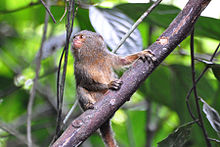
Specialised claws permit the pygmy marmoset to cling to copse while feeding.
This monkey has a specialized diet of tree glue. It gnaws holes in the bark of advisable trees and vines with its specialized dentition to elicit the production of gum. When the sap puddles up in the hole, it laps information technology up with its tongue. It as well lies in expect for insects, especially butterflies, which are attracted to the sap holes. Information technology supplements its nutrition with nectar and fruit.[xiv] A group's dwelling range is 0.ane to 0.four hectares (0.25 to 0.99 acres), and feeding is ordinarily concentrated on one or two trees at a time. When those get depleted, a group moves to a new home range. Dark-brown-mantled tamarins are generally sympatric with pygmy marmosets and often raid pygmy marmosets' gum holes.[half-dozen]
Pygmy marmosets have adapted insect-like claws, known equally tegulae, to engage in a loftier degree of claw-clinging behaviors associated with found exudate exploitation. Exudate is any material that oozes out of a plant, including mucilage, sap, resin, and latex.[15] Hook-clinging is primarily used during feeding, but likewise during found exudate foraging.[13]
Behaviour [edit]
A pygmy marmoset group, ranging from 2 to nine members, contains one or two adult males and ane or two adult females, including a single breeding female person and her offspring.[16] Interbirth interval ranges from 149–746 days.[17] In dissimilarity to other callitrichines, there is no relationship between the number of adult males and the number of infants and offspring. Nevertheless, at that place is a pregnant positive relationship between the number of juveniles and the number of adult and sub-adult group members.[xviii] Young marmosets typically remain in the group for ii sequent birth cycles. The pygmy marmoset uses special types of communication to give alerts and warning to its family members. These include chemical, vocal, and visual types of communication.[nineteen] It is believed to serve to promote grouping cohesion and avoidance of other family groups.[xx]
[edit]
Infant pygmy marmosets, along with their parents, twin, and other siblings, form cooperative intendance groups. Babbling, or vocalizing, by the baby marmoset is a central function of its relationships with its family members and is a major part of its development. As the infant develops, the babbling gradually changes to resemble and eventually become developed vocalization. There are many similarities between the development of vocalization in babe pygmy marmosets and speech in infant humans. Vocalizing gives the baby advantages such equally increased care and allows the unabridged family to coordinate their activities without seeing each other.[21]

Pygmy marmosets live in groups of two to nine individuals.
Siblings as well participate in infant care. Infant marmosets crave the nearly attending, so having more family members participating in the care decreases the cost for any individual and also teaches parenting skills to the juvenile marmosets. Members of the group, normally female person, may fifty-fifty put off their own reproduction through a temporary cessation of ovulation in gild to care for the offspring of others in the group. The ideal number of caregivers for an babe marmoset has been shown to be around five individuals. Caregivers are responsible for finding food for the infants likewise as helping the begetter spotter for predators.[22]
The pygmy marmoset is a non-seasonal breeder and ordinarily gives birth to twins once or twice a year.[23] Nonetheless, single births occur 16% of the time and triplet births eight% of the fourth dimension.[17] The pygmy marmoset is usually monogamous though at that place is some variation inside the species in terms of convenance systems. Polyandry also occurs as male marmosets are responsible for carrying the infants on their backs. Having a second male to deport the offspring can be beneficial as marmoset litters are often twins and decreases the price to whatever particular male. The daily range of the pygmy marmoset, however, is relatively small, which decreases the rate of polyandry.[24]
Male and female person pygmy marmosets testify differences in foraging and feeding behavior, although male person and female dominance and aggressive behavior varies inside the species. Males have less time to search out food sources and provender due to the constraints of their infant caring responsibilities and predator vigilance. Without an baby to carry, female person pygmy marmosets have greater freedom to forage, giving them an credible feeding priority. This priority may serve to recoup mothers for the energetic costs of carrying and lactating for two offspring at a fourth dimension. However, the fact that feeding priority is besides given to females without offspring weakens the statement. Instead, female feeding priority may have evolved through sexual selection. Females may choose mates who invest more time in infant care and predator vigilance. Such males accept less time to look for nutrient, assuasive the female feeding priority.[25]
Communication [edit]

Groups use contact calls to stay together when foraging, feeding, and travelling.
The pygmy marmoset is well known for its communication abilities including an intricate organisation of calls. The trill is used during feeding, foraging, and when travelling and the group is close together. The J-call is a serial of fast notes repeated by the caller and is used at medium distances. Both calls are used as contact calls. The long phone call is used when the group is spread out over distances greater than ten meters or in response to a neighboring group.[19] The pygmy marmoset uses the trill for brusque-distance communication, J-calls for intermediate distances, and long calls for long distances; these have respectively decreasing frequencies. Pigmy marmosets interpret these calls not only by type only also, through subtle sonic variance, past individual calling. Research based on sound playback tests shows that calls recorded from dissimilar individuals in captivity varied significantly in all seven auditory parameters analyzed for each type of call. Behavioral responses to trills were greatest when the caller was the dominant male person of the group. Responses to J-calls were greatest when the caller was the monkey's mate or a same-sexual practice monkey from outside the group. Varying responses to private callers were only observed when the phone call was given spontaneously from another animal rather than being played back from a recording, with one exception. That exception was that male person monkeys responded to playbacks of their own calls differently from those of other monkeys, when the telephone call was played back from a familiar location. It is thought the pygmy marmoset reacts at first to the type of call that is beingness made and then adjusts its behavior slightly to react to the specific individual that is making the call. This allows the marmoset to react accordingly to all calls but testify some variation when the telephone call gives extra information.[20]
Environmental factors play a role in communication by affecting the frequency of the signal and how far the point can travel and still be audible to communicate the desired message. Since the pygmy marmoset is often establish in the rain woods, plant life and the humid temper add to the normal assimilation and scattering of audio. Because low frequency calls are afflicted less past the disturbances than their high frequency counterparts, they are used for communication across longer distances.[nineteen] The pygmy marmoset changes the characteristics of its calls when its social environment is changed. Adult marmosets will bear witness modifications in the structure of their calls which mimic that of their group members. In addition to changes of existing calls, novel calls may be heard from marmosets after pairing.[26]
The pygmy marmoset has other means to communicate information about matters such equally the female's ovulatory state. New World monkeys practise not show genital swelling during ovulation as female Sometime World monkeys practice. Instead, a lack of female person aggression towards males can serve every bit a betoken of ovulation. Scent glands on its chest, anus, and genitals are also rubbed on surfaces which leave chemic signals nearly the reproductive country of the female person.[27] The pygmy marmoset likewise performs visual displays such every bit strutting, back-arching, and piloerection when it feels threatened or to evidence authorization.[28]
Conservation [edit]
They are threatened by habitat loss in some areas of its range, and by the pet merchandise in others (i.eastward. Ecuador).[vi] Interaction between humans and the pygmy marmoset is associated with a number of behavioral changes in the animal including social play and vocalization, both of which are of import to communication between animals in the species. Especially in areas of heavy tourism, pygmy marmosets take a tendency to be less noisy, less aggressive, and less playful with other individuals. They are also pushed into higher strata of the rainforest than they would ordinarily prefer. Tourism in areas native to the pygmy marmoset is also correlated with increased capture of the beast. Due to its small size and relatively docile nature, captured pygmy marmosets are often institute in exotic pet trades.[29] Capture causes even more behavioral variations, including a decrease in both the number and the sound level of vocalizations.[30] Pygmy marmosets can also be found at local zoos, where they exist in groups.[31]
Every bit pets [edit]
Finger monkeys' (pygmy marmoset) value is associated with them being the smallest primate in the world. New-born pygmy marmosets are ordinarily five–six inches (130–150 mm) alpine, and weigh from 100 grams (three.5 oz).[32] Although these primates are not in danger of extinction, they are rare to find in the market for buy. Prices range from $1,000 to $iv,000.[32] Mostly, a pygmy marmoset's life bridge is from 15 to 20 years, they are known to have a shorter life in the wild mainly because they fall out of copse.[33]
Another expense for these creatures every bit pets is the necessary essentials in social club to maintain them. Creating an environment similar to that of where they are from is of import.[34] For food, these creatures as pets are oft fed fruits, insects, and smaller lizards.[35] As pets, a baby pygmy marmoset needs to exist fed every two hours for at least two weeks.[32] Understanding their natural diet is too important because it helps maintain their expert health from the necessary protein, calcium and other nutritional sources they need in order to survive.
In the United States, each state has different regulations when it comes to owning i of these creatures.[32] Some other cistron that needs to be considered is that a regular veterinarian might non be able to help provide medical evaluations or care; ane would need to seek out a veterinarian with a primate specialization.[33] In South America it is illegal to either import or export these creatures. Agreement the laws within those countries is important when it comes to considering owning or taking intendance of a pygmy marmoset. Many people do not agree that pygmy marmosets should exist pets.[34] The argument is usually that they have a longer life span when they are in good care from a human.[35] However, the Uk RSPCA says they should "not exist considered as pets in the accepted sense of the word. They are wild undomesticated animals that cannot exist house-trained or fully tamed".[36]
In popular civilization [edit]
- Fingerlings, the hit toy of Christmas 2017 produced past WowWee, is based on pygmy marmosets.[37]
See also [edit]
References [edit]
- ^ a b Groves, C. P. (2005). "Order Primates". In Wilson, D. East.; Reeder, D. M (eds.). Mammal Species of the World: A Taxonomic and Geographic Reference (tertiary ed.). Johns Hopkins University Press. p. 132. ISBN978-0-8018-8221-0. OCLC 62265494.
- ^ a b Rylands, A. B.; Mittermeier, R. A. (2009). "The diversity of the New Globe primates (Platyrrhini)". In Garber, P. A.; Estrada, A.; Bicca-Marques, J. C.; Heymann, E. W.; Strier, Yard. B. (eds.). S American Primates: Comparative Perspectives in the Study of Behavior, Ecology, and Conservation. Springer. pp. 23–54. ISBN978-0-387-78704-6.
- ^ Soini, Pekka (1982). "Ecology and Population Dynamics of the Pygmy Marmoset, Cebuella Pygmaea". Folia Primatologica. 39 (one–ii): ane–21. doi:10.1159/000156066. PMID 6815036.
- ^ de la Torre, Stella; Snowdon, Charles T.; Bejarano, Monserrat (2000). "Effects of human activities on wild pygmy marmosets in Ecuadorian Amazonia". Biological Conservation. 94 (2): 153–163. doi:10.1016/S0006-3207(99)00183-4.
- ^ Barroso, C. G. L.; Schneider, H.; Schneider, 1000. P. C.; Sampaio, I.; Harada, M. L.; Czelusniak, J.; Goodman, M. (1997). "Update on the phylogenetic systematics of New World monkeys: Further DNA evidence for placing the pygmy marmoset (Cebuella) within the genus Callithrix". International Journal of Primatology. 18 (4): 651–674. doi:10.1023/A:1026371408379. S2CID 24741900.
- ^ a b c d Rylands, A.B. & de la Torre, Due south. 2008. Cebuella pygmaea ssp. pygmaea. The IUCN Blood-red List of Threatened Species 2008: east.T136926A4350391. https://dx.doi.org/x.2305/IUCN.UK.2008.RLTS.T136926A4350391.en. Downloaded on 9 July 2020.
- ^ Groves, Colin P. (2001). Primate Taxonomy. Smithsonian.
- ^ Montgomery, S. H.; Mundy, N. I. (2013). "Parallel episodes of phyletic dwarfism in callitrichid and cheirogaleid primates". Periodical of Evolutionary Biology. 26 (iv): 810–819. doi:10.1111/jeb.12097. PMID 23442013.
- ^ Nowak, R. M. (1999). Walker's Mammals of the World (6th ed.). Baltimore and London: The Johns Hopkins University Press. p. 566. ISBN978-0-8018-5789-8.
- ^ a b c Soini, P. (1982). "Ecology and population dynamics of the pygmy marmoset, Cebuella pygmaea". Folia Primatologica. 39 (1–2): 1–21. doi:10.1159/000156066. PMID 6815036.
- ^ a b Kinzey, W. 1000. (1997). "Synopsis of New World primates (xvi genera)". In Kinzey, W. Chiliad. (ed.). New World Primates: Environmental, Evolution, and Behavior. New York: Aldine De Gruyter. pp. 169–324.
- ^ a b Sussman, R. Westward. (2000). Primate Ecology and Social Construction. Vol. two: New Earth Monkeys. Needham Heights, MA: Pearson Custom Publishing.
- ^ a b Jackson, C. P. (2011). "The positional behavior of pygmy marmosets (Cebuella pygmaea) in northwestern Bolivia". Primates. 52 (2): 171–178. doi:ten.1007/s10329-011-0237-7. PMID 21360318. S2CID 36923830.
- ^ Genoud, 1000.; Martin, R. D.; Glaser, D. (1997). "Rate of metabolism in the smallest simian primate, the pygmy marmoset (Cebuella pygmaea)". American Periodical of Primatology. 41 (iii): 229–245. doi:10.1002/(SICI)1098-2345(1997)41:3<229::Assist-AJP5>3.0.CO;2-Z. PMID 9057967.
- ^ Lang, Kristina Cawthon. "Primate Factsheets: Pygmy marmoset (Callithrix pygmaea) Taxonomy, Morphology, & Environmental". Retrieved 24 September 2013.
- ^ Nancy M. Solomon; Jeffrey A. French (1997). Cooperative Convenance in Mammals . Cambridge University Press. pp. 51–54. ISBN9780521454919.
- ^ a b Ziegler, T. E.; Snowdon, C. T.; Bridson, W. E. (1990). "Reproductive functioning and excretion of urinary estrogens and gonadotropins in the female pygmy marmoset (Cebuella pygmaea)". American Journal of Primatology. 22 (3): 191–203. doi:10.1002/ajp.1350220305. PMID 31952429. S2CID 86258142.
- ^ Heymann, E. W.; Soini, P. (1999). "Offspring number in pygmy marmosets, Cebuella pygmaea, in relation to group size and the number of adult males". Behavioral Environmental and Sociobiology. 46 (6): 400–404. doi:ten.1007/s002650050635. S2CID 23577540.
- ^ a b c de la Torre, South.; Snowdon, C. T. (2002). "Environmental correlates of vocal communication of wild pygmy marmosets, Cebuella pygmaea". Animal Behaviour. 63 (5): 847–856. doi:10.1006/anbe.2001.1978. S2CID 53188541.
- ^ a b Snowdon, C. T.; Cleveland, J. (1980). "Individual recognition of contact calls by pygmy marmosets". Animal Behaviour. 28 (3): 717–727. doi:x.1016/S0003-3472(80)80131-X. S2CID 53186935.
- ^ Elowson, A. Grand.; Snowdon, C. T.; Lazaro-Perea, C. (1998). "'Blathering' and social context in infant monkeys: Parallels to human infants". Trends in Cognitive Sciences. 2 (1): 31–37. doi:ten.1016/S1364-6613(97)01115-7. PMID 21244960. S2CID 20241230.
- ^ Snowdon, C. T.; Ziegler, T. East. (2007). "Growing up cooperatively: Family processes and babe care in marmosets and tamarins" (PDF). The Journal of Developmental Processes. 2 (1): 40–66. Retrieved 22 November 2012.
- ^ Goldizen, A. West. (1988). "Tamarin and marmoset mating systems: Unusual flexibility" (PDF). Trends in Ecology & Evolution. 3 (ii): 36–56. doi:ten.1016/0169-5347(88)90045-6. hdl:2027.42/27403. PMID 21227069.
- ^ Davies, N. B.; Krebs, J. R.; W, S. A. (2012). "Mating systems". An Introduction to Behavioural Ecology. John Wiley & Sons. p. 258. ISBN978-1-4443-9845-8 . Retrieved i December 2012.
- ^ Bicca-Marques, J. C. (2003). "Sexual selection and the evolution of foraging behavior in male and female tamarins and marmosets" (PDF). In Jones, C. (ed.). Sexual Selection and Reproductive Competition in Primates: New Perspectives and Directions. Norman, OK: American Society of Primatologists. pp. 455–475.
- ^ Snowdon, C. T.; Elowson, A. M. (1999). "Pygmy marmosets modify call structure when paired". Ethology. 105 (10): 893–908. doi:10.1046/j.1439-0310.1999.00483.x.
- ^ Converse, 50. J.; Carlson, A. A.; Ziegler, T. Due east.; Snowdon, C. T. (1995). "Communication of ovulatory country to mates by female person pygmy marmosets, Cebuella pygmaea". Animal Behaviour. 49 (3): 615–621. doi:10.1016/0003-3472(95)80194-4. S2CID 54321327.
- ^ Soini, P. (1988). "The pygmy marmoset, genus Cebuella". In Mittermeier, R. A.; Coimbra-Filho, A. F.; da Fonseca, G. A. B. (eds.). Ecology and Beliefs of Neotropical Primates. Vol. 2. Washington DC: World Wildlife Fund. pp. 79–129. OCLC 180684863.
- ^ Suddath, Claire. "Pygmy Marmoset." Time.com. Time, three Jan. 2011. Web. 26 Sept. 2013.
- ^ de la Torre, S. (2000). "Effects of human activities on wild pygmy marmosets in Ecuadorian Amazonia". Biological Conservation. 94 (two): 153–163. doi:x.1016/S0006-3207(99)00183-four.
- ^ "Pygmy Marmoset." Sandiego Zoo. Sandiego Zoo, n.d. Web. 26 Sept. 2013.
- ^ a b c d Douglas, Long. "How Much Does a Finger Monkey Cost?". FingerMonkey.us . Retrieved 24 March 2018.
- ^ a b Kulwant, Singh. "Finger Monkey: Data, Fact and Cost of keeping". loyfly. loyfly. Retrieved 24 March 2018.
- ^ a b Ben, Garrod (28 February 2016). "No more monkey business: why primates should never be pets". The Guardian . Retrieved 25 March 2018.
- ^ a b National Primate Research Centre. "Primates as Pets". Primate Info Cyberspace. University of Wisconsin. Retrieved 25 March 2018.
- ^ "Primates kept every bit pets | rspca.org.uk". RSPCA. Retrieved 28 July 2020.
- ^ Corkery, Michael (ix December 2017). "How the Fingerling Caught On (Robot Grip and All) as 2017's Hot Toy". The New York Times.
External links [edit]
- Twin albino pygmy marmosets born in Sweden
- Primate Info Net Callithrix pygmaea Factsheet
Source: https://en.wikipedia.org/wiki/Pygmy_marmoset
0 Response to "Tiniest Monkey in the World Tiniest Baby in the World"
Postar um comentário